Finding out you or a loved one has a brain tumor is life-altering. The first question many patients ask is, “Can brain tumor be treated without surgery?” While surgery is a common path, it is not the only one. Thanks to breakthroughs in medical technology in 2026, many patients now have access to highly effective non-invasive treatments. Whether a tumor is deep-seated, located near critical brain structures, or if a patient’s health makes surgery risky, non-surgical interventions offer hope and healing. This guide explores how modern medicine manages brain tumors through precision and innovation.
Understanding Brain Tumors and Non-Surgical Eligibility
A brain tumor is an abnormal growth of cells within the skull. These are broadly categorized into primary tumors (starting in the brain) and metastatic tumors (spreading from elsewhere). The answer to “Can brain tumor be treated without surgery?” largely depends on the tumor’s type, size, grade, and location. For instance, benign tumors like certain meningiomas or functional tumors like acoustic neuromas are often prime candidates for non-surgical management. The best neurosurgeon Doctors use a multidisciplinary approach to determine if a patient can skip the operating room in favor of targeted therapies that preserve brain function and quality of life.
Common Causes and Risk Factors
While the exact cause of most brain tumors remains a subject of intense research, several factors increase the likelihood of development:
- Genetic Predispositions: Certain inherited syndromes like Neurofibromatosis or Li-Fraumeni syndrome.
- Radiation Exposure: Previous exposure to ionizing radiation, often from earlier medical treatments.
- Age: While they can occur at any age, the risk generally increases as people get older.
- Secondary Spread: Cancers from the lungs, breast, or colon spreading to the brain.
Symptoms That Require Attention
Recognizing symptoms early is crucial for successful non-surgical intervention. Common signs include:
- Persistent, worsening headaches (often worse in the morning).
- Seizures in someone who has no history of them.
- Cognitive changes, memory loss, or personality shifts.
- Vision problems, such as blurred vision or loss of peripheral sight.
- Balance issues and unexplained nausea or vomiting.
How Brain Tumors are Diagnosed
Before answering “Can brain tumor be treated without surgery?” for a specific case, doctors must visualize the growth. Diagnostic steps include:
- Neurological Exam: Checking vision, hearing, balance, and reflexes.
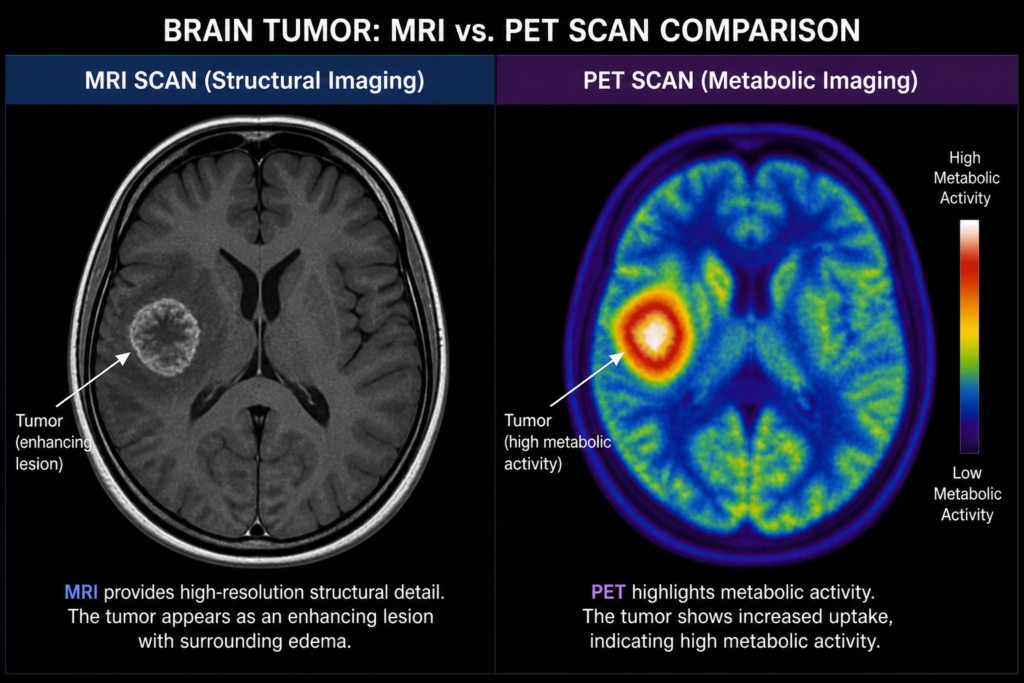
- MRI (Magnetic Resonance Imaging): The gold standard for seeing brain structures clearly.
- CT Scan: Useful for checking bone involvement or acute bleeding.
- PET Scan: Helps determine if a tumor is active or growing.
- Biopsy: Sometimes done via a needle (minimally invasive) to identify the cell type.
Non-Surgical Treatment Options
If you are wondering how a brain tumor can be treated without surgery, several advanced modalities are currently leading the way in 2026:
1. Stereotactic Radiosurgery (SRS)
Despite the name, this is not surgery. It involves no incisions. Using systems like CyberKnife or Gamma Knife, doctors deliver highly concentrated beams of radiation directly to the tumor. This shrinks or destroys the tumor while sparing the surrounding healthy tissue. It is often the preferred choice for small, well-defined tumors.
2. Radiation Therapy
External beam radiation uses high-energy X-rays to kill cancer cells. Modern techniques like IMRT (Intensity-Modulated Radiation Therapy) allow doctors to shape the radiation to the exact dimensions of the tumor, reducing side effects.
3. Chemotherapy and Targeted Therapy
Chemotherapy involves drugs that stop the growth of tumor cells. Targeted therapies are newer drugs that attack specific “weaknesses” in cancer cells without harming normal cells. These are often used for malignant tumors or those that have returned after previous treatment.
4. Tumor Treating Fields (TTFields)
This non-invasive therapy uses electric fields to interfere with the division of cancer cells. Patients wear a portable device that delivers these fields through the scalp, making it a viable long-term management strategy for certain aggressive tumors.
5. Medication Management
In some cases, especially with small, slow-growing benign tumors, the “treatment” is active surveillance combined with medications to manage symptoms like swelling (steroids) or seizures (anti-epileptics).
Comparison of Surgical vs. Non-Surgical Approaches
| Feature | Surgical Resection | Non-Surgical (Radiosurgery/Chemo) |
|---|---|---|
| Invasiveness | High (Incision required) | Low to None |
| Recovery Time | Weeks to Months | Days |
| Hospital Stay | 3–7 Days | Often Outpatient |
| Risk of Infection | Present | Minimal |
| Best For | Large, accessible tumors | Deep, small, or high-risk tumors |
Risks and Side Effects of Non-Surgical Care
While avoiding the knife reduces many risks, non-surgical paths have their own considerations:
- Fatigue: The most common side effect of radiation and chemo.
- Skin Irritation: Redness or sensitivity at the site of radiation.
- Brain Swelling: Can occur as the tumor reacts to treatment, usually managed with steroids.
- Nausea: Primarily associated with systemic chemotherapy.
Recovery and Long-Term Prevention
Recovery from non-surgical treatments is generally faster. Patients are encouraged to maintain a healthy diet, stay hydrated, and engage in cognitive exercises. While you cannot “prevent” a brain tumor with 100% certainty, reducing radiation exposure and maintaining overall neurological health through regular check-ups is vital.

When to See a Doctor
You should consult a specialist in brain tumors immediately if you experience sudden neurological deficits, unexplained seizures, or a drastic change in your vision or speech. Early detection often makes the difference in whether a brain tumor can be treated without surgery.
Expert Guidance for Your Neurological Health
Every brain tumor case is unique. If you are exploring non-surgical treatment options, our specialists are ready to provide a comprehensive evaluation and a personalized care plan.
Consult a Specialist TodayGet a second opinion from India’s leading neuro-experts.
Conclusion
The answer to “Can brain tumor be treated without surgery?” is a resounding yes for many patients in the modern era. From the precision of CyberKnife treatments to the efficacy of targeted drug therapies, the medical landscape has evolved. If you are seeking a comprehensive brain tumor consultation, it is essential to speak with experts who understand the nuances of non-invasive care.
Frequently Asked Questions (FAQs)
1. Can a malignant brain tumor be cured without surgery?
While “cure” depends on the specific pathology, many malignant tumors are effectively managed and put into remission using a combination of high-dose radiation and chemotherapy without the need for traditional open surgery. Modern protocols focus on long-term control and quality of life.
2. What is the most successful non-surgical treatment for brain tumors?
Stereotactic Radiosurgery (SRS), such as CyberKnife, is highly successful for small to medium-sized tumors. It offers success rates comparable to surgery for specific tumor types, like acoustic neuromas or meningiomas, because it delivers precise radiation that destroys the DNA of tumor cells.
3. How long does non-surgical brain tumor treatment take?
Radiosurgery can often be completed in 1 to 5 sessions, whereas traditional radiation or chemotherapy may span several weeks. Most non-surgical treatments are performed on an outpatient basis, meaning you can go home the same day.
4. Are non-surgical treatments safer for elderly patients?
Generally, yes. Since there is no general anesthesia, risk of surgical hemorrhage, or intensive care recovery, non-surgical options are often the preferred route for elderly patients or those with underlying health conditions like heart disease.
5. Will the tumor disappear immediately after non-surgical treatment?
No, non-surgical treatments like radiation work over time. The tumor cells lose their ability to divide and slowly shrink or stabilize over weeks or months. Regular follow-up MRI scans are required to monitor the gradual reduction in size.
6. Can all types of brain tumors be treated without surgery?
Not all. Very large tumors causing immediate pressure on the brain (mass effect) or those requiring an immediate tissue sample for diagnosis may still necessitate surgical intervention. A specialized neurosurgeon can determine the best course after reviewing your scans.