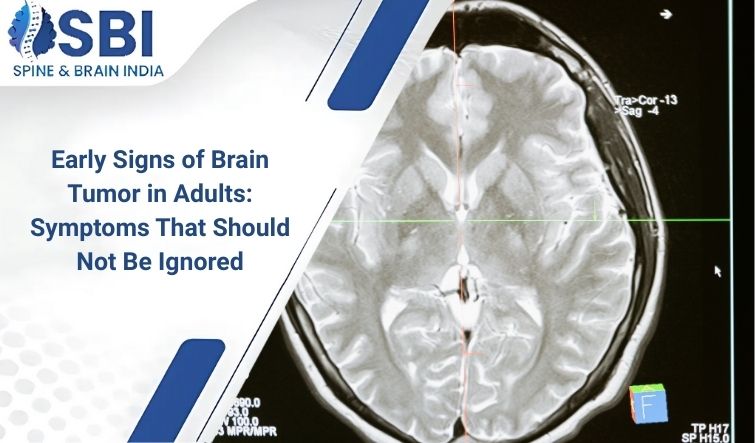
Brain tumors in adults can present with subtle symptoms that are often mistaken for stress, migraine, aging, or routine neurological issues. While not every headache or episode of dizziness indicates a tumor, persistent, progressive, or unusual neurological symptoms should never be ignored. Early recognition allows timely diagnosis, safer treatment options, and better outcomes.
This article explains the early signs of brain tumor in adults, how symptoms develop, when to seek medical care, and why early evaluation is critical.
Understanding Brain Tumors in Adults
A brain tumor is an abnormal growth of cells within the brain or surrounding structures. Tumors may be benign (non-cancerous) or malignant (cancerous), but both can cause serious symptoms due to pressure on delicate brain tissue.
Symptoms depend on:
- Tumor size
- Location in the brain
- Growth rate
- Involvement of surrounding nerves or structures
Because the skull is a closed space, even slow-growing tumors can eventually cause symptoms due to increased pressure.
Early Signs of Brain Tumor in Adults
Persistent Headaches That Are Different From Usual
Headaches related to brain tumors are often progressive and feel different from typical tension headaches or migraines. They may be worse in the early morning or increase with coughing, bending, or straining. Pain relief medications may provide only temporary relief.
Unlike common headaches, these tend to increase in frequency and intensity over time.
Seizures With No Previous History
A first-time seizure in an adult is one of the most important early warning signs of a brain tumor. Seizures may present as sudden jerking movements, brief loss of awareness, confusion, or abnormal sensations.
Even a single unexplained seizure requires immediate neurological evaluation.
Changes in Vision
Visual symptoms often occur when tumors affect areas responsible for sight or increase pressure inside the skull. Adults may notice blurred vision, double vision, difficulty focusing, or loss of peripheral vision.
These changes may develop gradually and worsen over weeks or months.
Difficulty With Speech or Understanding
Tumors in language-related brain regions can cause difficulty speaking clearly, finding the right words, or understanding conversations. Family members often notice these changes before the patient does.
Speech-related symptoms that progress should be taken seriously.
Weakness or Numbness on One Side of the Body
Unexplained weakness, numbness, or tingling in the face, arm, or leg—especially on one side—can be an early sign of brain involvement. This may start subtly and worsen gradually.
Such symptoms are often mistaken for cervical spine problems or stroke-related issues.
Balance Problems and Coordination Issues
Adults with brain tumors may experience frequent falls, unsteadiness, dizziness, or difficulty walking straight. These symptoms occur when tumors affect the cerebellum or balance centers of the brain.
Persistent balance problems without an obvious cause warrant further investigation.
Cognitive and Behavioral Changes
Memory Problems
Short-term memory loss, difficulty concentrating, or confusion can be early signs, particularly when symptoms worsen over time. These changes are often misattributed to stress or aging.
Personality or Mood Changes
Brain tumors can alter emotional regulation, leading to irritability, depression, anxiety, or sudden personality changes. These behavioral symptoms may appear before physical signs.
Symptoms Based on Tumor Location
| Brain Area Affected | Common Early Symptoms |
|---|---|
| Frontal lobe | Personality changes, poor judgment, weakness |
| Temporal lobe | Memory loss, speech difficulty, seizures |
| Parietal lobe | Sensory changes, spatial problems |
| Occipital lobe | Vision disturbances |
| Cerebellum | Balance and coordination issues |
| Brainstem | Swallowing difficulty, double vision |
General Symptoms Caused by Increased Brain Pressure
As tumors grow, they may increase pressure within the skull, leading to additional symptoms.
| Symptom | Explanation |
|---|---|
| Morning headaches | Raised intracranial pressure |
| Nausea or vomiting | Pressure on vomiting center |
| Drowsiness | Reduced brain function |
| Confusion | Impaired cognitive processing |
When Symptoms Should Not Be Ignored
Medical evaluation is strongly advised if symptoms:
- Persist or worsen over weeks
- Appear suddenly without explanation
- Affect daily activities or work
- Occur together, such as headache with vision changes
Adults in Delhi, Gurgaon, Noida, and nearby regions often delay evaluation until symptoms interfere with routine life, which can reduce treatment options.
How Brain Tumors Are Diagnosed
Diagnosis begins with a detailed neurological examination. Imaging plays a critical role.
| Test | Purpose |
|---|---|
| MRI Brain | Detects tumors and location |
| CT Scan | Useful in emergencies |
| EEG | Evaluates seizure activity |
| Biopsy | Confirms tumor type |
Early imaging significantly improves treatment planning and outcomes.
Can Early Detection Improve Survival?
Yes. Early diagnosis allows:
- Less extensive surgery
- Better neurological recovery
- More treatment options
- Improved quality of life
Many brain tumors are treatable when identified before significant neurological damage occurs.
Treatment Options After Diagnosis
Treatment depends on tumor type, size, and location and may include:
- Careful monitoring
- Surgical removal
- Radiation therapy
- Medical management
Treatment plans are individualized and often involve a multidisciplinary team.
Frequently Asked Questions (FAQs)
What are the earliest symptoms of a brain tumor in adults?
Persistent headaches, seizures, vision changes, and gradual neurological deficits are common early signs.
Can brain tumor symptoms come and go?
Yes, early symptoms may fluctuate, which often delays diagnosis.
Are all brain tumors cancerous?
No, many brain tumors are benign but can still cause serious symptoms due to pressure on the brain.
When should an MRI be done for headaches?
MRI is recommended when headaches are progressive, associated with neurological symptoms, or different from usual patterns.
Can stress cause symptoms similar to a brain tumor?
Stress can mimic some symptoms, but progressive neurological signs should always be medically evaluated.
Conclusion
Early signs of brain tumor in adults are often subtle and easily overlooked. Persistent headaches, seizures, vision changes, weakness, and behavioral alterations should never be ignored. Timely medical evaluation and imaging can make a life-changing difference by enabling early treatment and preventing permanent neurological damage.